
How to Human
The Idea to Foster our Collective Potential

So I recently contemplated about the concept of cultivation. Across human history the species homo sapiens always spend at least some effort in cultivating not only its environment to mend it towards its needs (even to the extend of exploiting it), but also its people and their competencies.
We are after all a crafty bunch. And once some of us have unlocked a skill, it does not take long till this advantage ripples out to the rest of us.
The culmination of this effort resulted in the creation of our modern education system. (With argueably lackluster execution)
We show our newest generation the wonder of an enlightend understanding of the natural world. Sciences give insight into the mechanics of nature, Humanities allow us to understand Society and History. We have Arts and Crafts, Philosophy, Psychology and of course Maths and Languages.
The Power of Knowledge is not to underestimate and increasing the literacy of the human population is probably the single most impactful cultural change that has ever occured. Together with the invention of the printing press and the most modern information technologies. Humans have unlocked a way to connect minds across time and space.
Only through this can humanity in a very tangible way, act as One.
The Utilization of this capability is of course in many ways questionable. And the most modern algorithmic fracturing of reality through information bubbles has devastating consequences, but the overall trajectory allows memetics (the biosphere of ideas at large) to spread and evolve at an unprecedented rate. And once humans acclimate to this the potential is unfathomable. (IF humanity manages to acclimate)
However I do see one category in which humans have made inadequate effort and advances regarding our focused cultivation..
Human 101
The idea is quiet simple. Why do we lead our personal development to individual ignorance?
Psychology holds some insight into this domain another is (ab)used as coaching content. Another is held by spiritual traditions trying to cultivate ones soul and virtues and one more is found in fitness and dietary knowledge.
Philosophy is actually another big pillar of human cultivation. But not only are those individual areas of expertise fragmented and often littered with misinformation for a quick buck to sell easy solutions, it also never quiet clicks into a coherent whole.
For example if one specializes in ones physical cultivation, learns about fitness, maximizes ones diet towards muscle gain and tries to achieve the peak physique. The consequences can be a neglect in many other domains. You either fall victim to body dismorphia, grind down your joints into dust or simply spend so much time in the gym that social life, personal education or other life goals fall short.
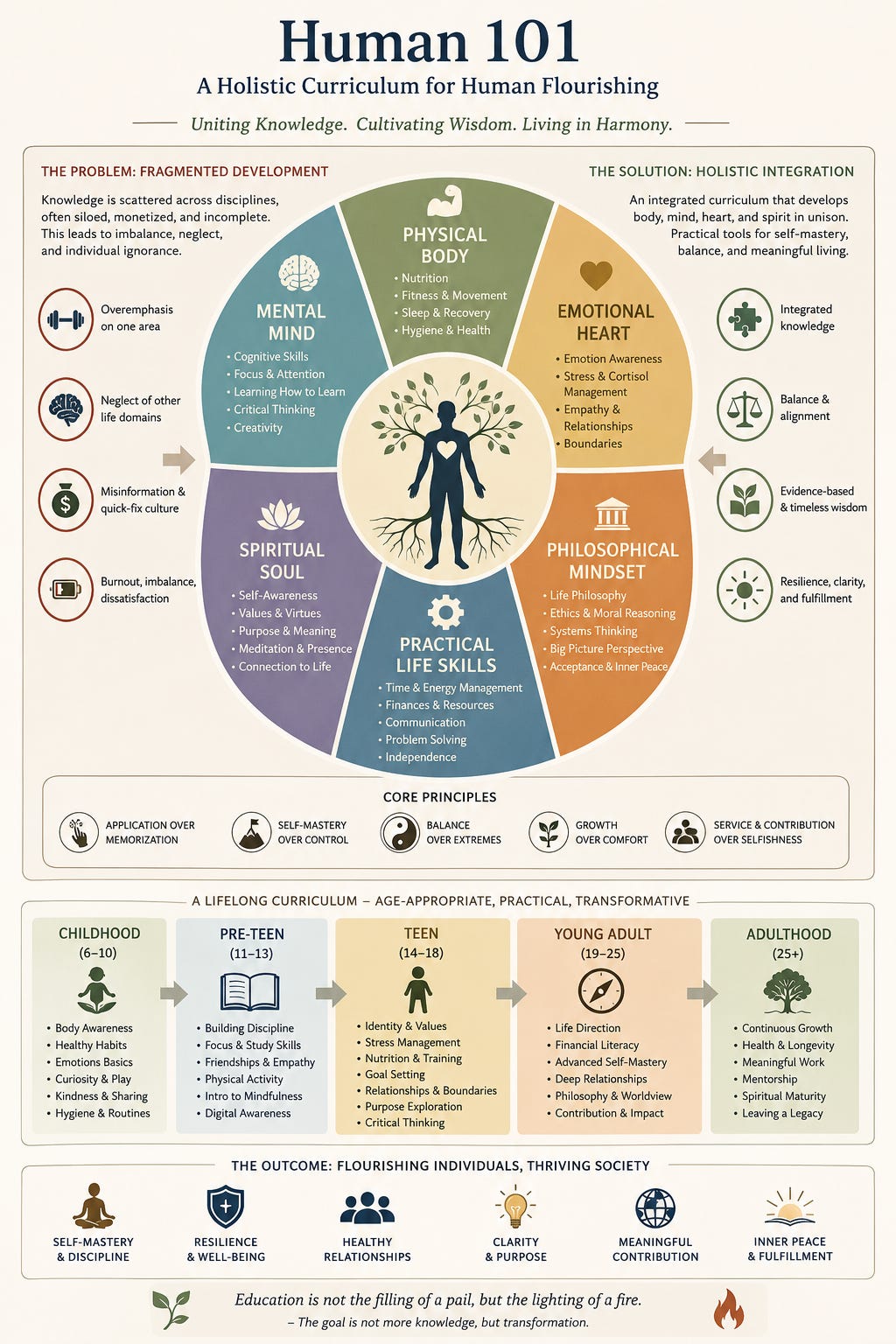
Creating a holistic curiculum in human flourishing. Teaching children impulse control, goal setting, cortisol management, the benefits of a healthy diet and physical fitness. How to cultivate ones mind through meditation. Learn to manage ones needs, even proper hygiene (cause there are still many households lacking the priviledge baseline we take for granted). Even spiritual development, developing a kind micro life philosophy (shoutout to Paul Musso, PhD 😁❤️) . Actually getting handed the tools to get to know themselves and work with their own mind and body in unison.
I think you get the jist of what I would like to achieve with such a subject across a childs school journey.
The beauty of education aimed not at simply transferring surface level knowledge into peoples brain with varying practical use is that this kind of self practice can allways be directly applied and holds direct benefit.
It furthers a qualitative transformation rather than just a quantitative accumulation of knowledge. While it cannot directly create wisdom it does fertilize the ground from which it more easily emerges.
Reaching Ones Potential
At its core the idea of inducing a qualitative change in individuals can be found across many schools of thought. the stoics, nietzsches Ubermensch, eastern enlightenment.. The list of ways in which people speak of personal self realization are endless.
What unites these traditions is not a shared metaphysics, but a shared direction. They all recognize that human beings are creatures capable of transforming themselves. Without this capability we remain in many ways passive observers of their own life unable to do much in the face of advercity.
“Until you make the unconscious conscious, it will direct your life and you will call it fate.”
― C.G. Jung
Of course over a lifetime much growth occurs naturally in most people faced with obstecales. But the unfortunate truth of todays reality is that while riddled with problems it has never the less (especially in the western part of the world) become too comfortable for our own good.
We are like a houseplant starting to wilt out of stress in a pot that became oppressive and to one dimensional, but also incapable of escaping this predicament because life never provided us with the tools to transcend our circumstances.
Modern education excels at transferring external knowledge. We learn mathematics, history, grammar and science. Yet we receive surprisingly little instruction on understanding the very instrument through which all of that knowledge is experienced: ourselves.
We memorize facts, but rarely learn how attention works. We solve equations, yet never practice emotional regulation. We study the laws governing the universe while remaining largely ignorant of the forces governing our own minds.
The consequence? Leaving development at the mercy of personal intuition. A handful of people grasp in between the lines and find a way through life that allows them to truly flourish. While many distract themselves in modern substitute stimulation sources that are finetuned in giving us the experience of progress without actually becoming any more proficient at life itself.
Carreer is one such jacobs ladder that might result in financial security but other than that rarely results in lifefullfillment. Games give us the ability to tangibly feel progress. See us aquire experience points, level ups just to close the game at the end of the story and return back to zero. fictional stories allow us to watch heros go on life changing journeys, experience adventures full of obstecales and overcomming ones limitation but leave us in the observing role never following in the footsteps of those role models.
Even at times the very books directed at selfhelp and personal growth can keep us in the loop of a false sense of improvement while never applying the insights provided.
To actually reach ones potential we have to strike while the iron is hot and give the tools to kids before they grow into habits and get used to the role of passive observer.
And more importantly. The lessons have to be applied. Human 101 should be a school subject without greats cause how awful would it be to be told you suck at being yourself. The only benchmark the student should compare their progress against is their past self.
And the benefit of having all these normally seperate domains contained in one subject? The holistic approach holds a positive feedback loop. Every domain feeds back into every other and progress steamroles. Whenever a person is stuck in one area they can progress in another before trying again with a strengthend foundation.
Children would gradually learn impulse control alongside arithmetic. They would understand stress before experiencing chronic anxiety. They would practice communication before entering relationships. Learn the basics of nutrition before advertising shaped their eating habits. Meditation would become as ordinary as physical education. Philosophy would not merely teach what others believed, but provide tools for examining one's own beliefs, values and purpose.
I’m under no delusion that this would create superhuman philosopher kings out of every child. The actual benefits would remain to be seen. But isnt it obvious that at least attempting to instill such values and tools into the future generations of our species is better than leaving it up to chance?
But Who’s Philosophy?
The touchy thing about teaching people about values, virtue or spirit naturally leads to the question of what the right answers even are and who the judge of this supposed human ideal would be. To put it slightly cynically the question is whether Human 101 is just a Trojan horse for somebody’s particular worldview.
Who gets to write this curriculum?
But notice the sleight of hand in the objection. We already teach logic without teaching people what conclusions to reach with it. We teach grammar without dictating what people are allowed to say. A curriculum can hand someone a tool without smuggling in the answer the tool is supposed to produce. Human 101 works the same way, or should. Teach the mechanics of attention, not what to pay attention to. Teach the anatomy of an argument, not which side of the argument to land on. Teach the physiology of stress, not what a person should or shouldn’t be stressed about. The spiritual and philosophical components stay procedural too: here is what contemplative traditions across the world have in common structurally, here is how to sit with a question rather than flinch away from it, here is what it looks like to actually examine a belief instead of just inheriting one. What conclusions a kid eventually reaches about meaning, god, or the good life stays entirely theirs.
The content-neutral version of this subject would in no way water down the idea. I think in many ways it’s the actual point of being human.
This subject would similarly guide people to their own conclusion but also of course allow for exchange and debate. Part of human flourishing stems from shared values and a community that helps out on everyones journey.
A different kind of teacher
Another suggestion I’d love to bring up here is that this subject actually gets taught by a mentor figure instead of a teacher. And for that we have to look elsewhere, at other traditions. Monasteries. Temple monks. or even Guilds of Craft.
India has been running exactly this experiment for millennia under the name guru-shishya parampara. The word parampara literally means lineage, a succession of teachers and disciples transmitting knowledge from guru to disciple after a formal initiation. The student traditionally even moved in with the guru for an immersive education. ( We don’t have to go that far xD)
Zen Buddhism built an entire ceremony around the exact moment where mentor and pupil finally stand eye to eye. It’s literally called face-to-face transmission, and the tradition describes it as the instant master and disciple have truly seen each other and been seen in return, at which point the successor is recognized as a peer in an unbroken lineage rather than a permanent understudy. Sufism has its own version in the murshid-murid relationship, where the disciple’s path formally begins with an oath of allegiance to a spiritual guide, and progress is marked in stages rather than semesters, with the guide personally certifying when the disciple is ready to move to the next one.
And this wasn’t only ever a spiritual arrangement. Medieval European guilds ran essentially the same architecture for carpenters, goldsmiths and blacksmiths. A young apprentice was bound to a master for years, and the only way to rise out of that position was to produce a “masterpiece,” a piece of work good enough that the master’s peers agreed you had actually arrived. A tangible thing you made with your own hands that a room full of masters looked at and decided, yes, this one’s ready, hand him the workshop.
Proximity, guidance and a concrete attachment figure across a long span of time allows them to absorb virtues and skills by the merits of a real human relationship. Growth and connection go hand in hand.
It’s a role that pretty much went extinct in modernity, and it’s a shame, because it has a lot of potential. Unlike most teachers, a mentor has the liberty to function both as a role model who actually resembles the virtues being taught (rather than someone who just describes them from behind a desk) and as someone close enough to their pupil to give them the experience of truly elevating their own position, of eventually meeting the mentor eye to eye at the end of their transformation. That “closeness” functions both as training wheels and guard rails that allow the “disciple” to probe their own capabilities and put trust in their growth by putting trust in their mentor.
We currently don’t have that. Once we become adults we do get some vague feeling of suddenly seeing our old teachers as fellow adults, but it’s never explicit, never meaningfully celebrated. It just happens somewhere in the background of your twenties, quietly, and nobody says anything. There’s no moment, no handshake, no one telling you plainly that the hierarchy you grew up inside of is over now and you’ve stepped outside of it.
In other words: current human children lack the experience of surpassing their “masters.” I use the word master deliberately here, because our society, while thankfully having abolished the social hierarchical position of the slave, nevertheless remains hierarchically organized, and people lack the experience of becoming a proper person, of actually breaking through the hierarchical position of “child.”
The result is devastatingly self-evident. It’s the origin of the popularized meme “everyone is twelve now.”

We don’t fully grow up without the experience of reaching our mentor and leaving them behind, because without that experience some part of us just keeps waiting for permission that never explicitly arrives.
Once graduated from Humanity 101, you actually have the means of going your own path. This is different from every other subject, where you merely achieve the basics and qualify for further study. Humanity 101 is complete in the sense that it makes you completely qualified for the challenge of being human. The journey ahead is obviously ongoing, and learning never ends, but from there, one gets officially handed the keys to one’s own fortune and fate.
We prepare people to be whole adults, knowing not just how to persist but to flourish.
The Outlook
Speaking of flourishing another way of looking at this course is through the lens of Eudaimonia.
Aristotle’s word, badly translated as “happiness”, despite being not at all about such a transient mood as mere happiness. It’s about flourishing. Wellbeing of mind body and soul.
Are you doing the thing you’re for? Is the life actually running, or just idling?
Think of Maslows hierarchy of needs. Eudaimonia doesn’t sit anywhere on there, its the whole thing. Finding your purpose in life is just as much part of it as brushing your teath.
If done well, thats what Human 101 hands the kid at graduation. A way to find and pursuit their own flourishing. Right now the closest thing an adult has to a self-check is their bank account, their job title, or whatever their group chat is doing on a given Tuesday. We operate on a very superficial layer, our happiness is fleeting and only a minority of people actually even know what they want from life.
Eudaimonia gives you an actual axis. You can fill the frame with any other kind of purpose. Its compatible with different religious frameworks, within atheism, capitalism or communism. No matter how society is structured, it strengthens the individual parts of the chain.
And the beauty of it is that it builds on fundamentals. The basics — sleep, food, a body you’re not fighting with. Covering the needs — connection, safety, some sense of being seen. Cultivating skills — impulse control, attention, the capacity to sit with a hard feeling instead of immediately outsourcing it to a phone.
All that leads us to cultivate what makes life worth experiencing. It makes us better humans. And would therefore make Humanity a better place.
second part: Cultivation in your private life and my problem with
“kundalini, chakra & co”
Oh my dear heavens, this is just beyond! The graphics, wow! I was just researching how the Woldwinites treated education/transmission and thinking about how it best could be improved upon, and here you are already doing the work far better than I ever could!
Accurate Diagnosis, Unrealistic Mechanism: Education for the Age of Extended Cognition
Contemporary education undeniably leaves a profound gap in one essential area: the cultivation of the individual. Alex correctly observes that schools teach mathematics, physics, history, and language, yet devote remarkably little attention to helping students understand and regulate the very instrument through which they experience all knowledge-their own minds.
In an age where attention has become a scarce resource and digital environments continuously compete for human cognition, this omission is no longer peripheral. It is one of the defining weaknesses of modern education.
It is therefore difficult to disagree with the broader intuition behind Humanity 101. Education should prepare young people not only for employment, but also for the lifelong task of directing their own lives. Skills such as emotional regulation, impulse control, sustained attention, healthy habits, and self-reflection deserve a far more prominent place within the educational system.
However, a correct diagnosis does not necessarily imply a workable solution.
The central weakness of Alex's proposal lies not in its objective but in the institutional mechanism chosen to achieve it.
The Scalability Paradox
The mentor-apprentice model described in Humanity 101 has deep historical roots. Monastic traditions, craft guilds, philosophical schools, and Eastern guru-disciple lineages all relied on long-term personal mentorship as the primary vehicle of transformation.
These systems shared three defining characteristics:
small numbers of students,
highly selective mentors,
years of sustained personal interaction.
Modern public education operates under precisely the opposite constraints. It must educate millions of students through standardized, repeatable, and economically sustainable institutions.
A nationwide educational system cannot realistically depend upon thousands of extraordinary mentors capable of guiding each student's psychological and existential development over many years. Such individuals are, almost by definition, rare.
This does not invalidate Alex's vision.
It merely demonstrates that the proposed mechanism was designed for elite educational communities rather than mass education.
The Real Transformation:->Extended Cognitive Systems
While the debate often focuses on human flourishing, the twenty-first century introduces an entirely different educational challenge.
The central problem is no longer scarcity of information.
It is informational abundance.
Artificial intelligence has fundamentally altered the structure of cognition itself. Increasingly, human reasoning is no longer performed in isolation but within extended cognitive systems consisting of humans, language models, search engines, computational tools, and simulations.
This changes the definition of competence.
The critical educational skill is no longer remembering information.
It is validating information.
The Validation Gap
Large language models produce fluent, coherent, and highly convincing answers that frequently exceed their users' capacity to evaluate them critically.
This creates a new manifestation of the Dunning–Kruger effect.
People become capable of generating sophisticated solutions through prompting long before they acquire the expertise required to determine whether those solutions are actually correct.
The ability to obtain an answer increasingly exceeds the ability to verify it.
This validation gap may become one of the defining cognitive risks of the AI era.
Consequently, the school of the future should not primarily function as a repository of information.
It should function as a laboratory for epistemic validation.
A New Educational Architecture
The objective identified by Alex remains valid: educating autonomous, resilient, and self-directed individuals.
The path toward that objective, however, should reflect the realities of contemporary technology rather than historical mentorship models.
A scalable educational architecture could instead emphasize three complementary principles.
Failure-First Assessment
Students should be evaluated less on producing the correct final answer and more on documenting how they identified, analyzed, and corrected mistakes made by themselves or by AI systems. Competence becomes measurable through the calibration of trust rather than simple correctness.
Red Team / Blue Team Learning
Students work in competing teams. One group constructs solutions using every available computational tool, while another attempts to identify hidden assumptions, logical inconsistencies, missing variables, or AI hallucinations. Learning becomes an exercise in systematic falsification rather than passive acceptance.
Domain Sandboxes
AI-generated theories should immediately encounter empirical resistance. Whether in laboratory experiments, engineering simulations, or physical prototypes, students learn where computational predictions succeed, where they fail, and why. The discrepancy between simulation and reality becomes the foundation of genuine understanding.
Conclusion
Alex's diagnosis is fundamentally correct.
Modern education does neglect the cultivation of the person behind the curriculum. Emotional regulation, attention management, self-awareness, and psychological resilience deserve far greater emphasis than they currently receive.
Where the proposal becomes problematic is not in its aspiration, but in its implementation.
Recreating historical mentor-disciple relationships is unlikely to succeed within the institutional realities of mass public education.
A more practical direction is to redesign education around cognitive validation, AI collaboration, and experimental verification.
Such an approach preserves Alex's central objective. The development of autonomous, thoughtful, and resilient human beings- while replacing an institutionally fragile model of mentorship with educational mechanisms that are scalable, measurable, and appropriate for an age in which intelligence itself has become an extended human-machine system.