
Morality: The Cage vs The Path
A field guide to the ethical life, with occasional baboons

We have in fact, two kinds of morality, side by side: one which we preach, but do not practice, and another which we practice, but seldom preach.
— Bertrand Russell
Spend enough time watching baboons and you start seeing humans.
Watch them groom each other, form alliances, even then cheat on their alliances the moment a better opportunity presents itself. The thing that keeps striking me is how thoroughly social their morality is. I use the word loosely and deliberately. When a baboon defers to the dominant male, when it hands over a piece of fruit it clearly wants or performs submission with that characteristic crouched posture, it is doing something recognizable. It is doing ethics. The ethics of: here is what this group expects of me, and here is what I can get away with. Performing a constant, exhausting negotiation between those two things.
Which, again: humans.
The question I want to sit with in this essay is whether that’s the whole story. Because I think we have two profoundly different things that we call morality, and we treat them as a single phenomenon, and this conflation produces enormous amounts of unnecessary suffering.
Let me give the two ways I want to discuss today a name.
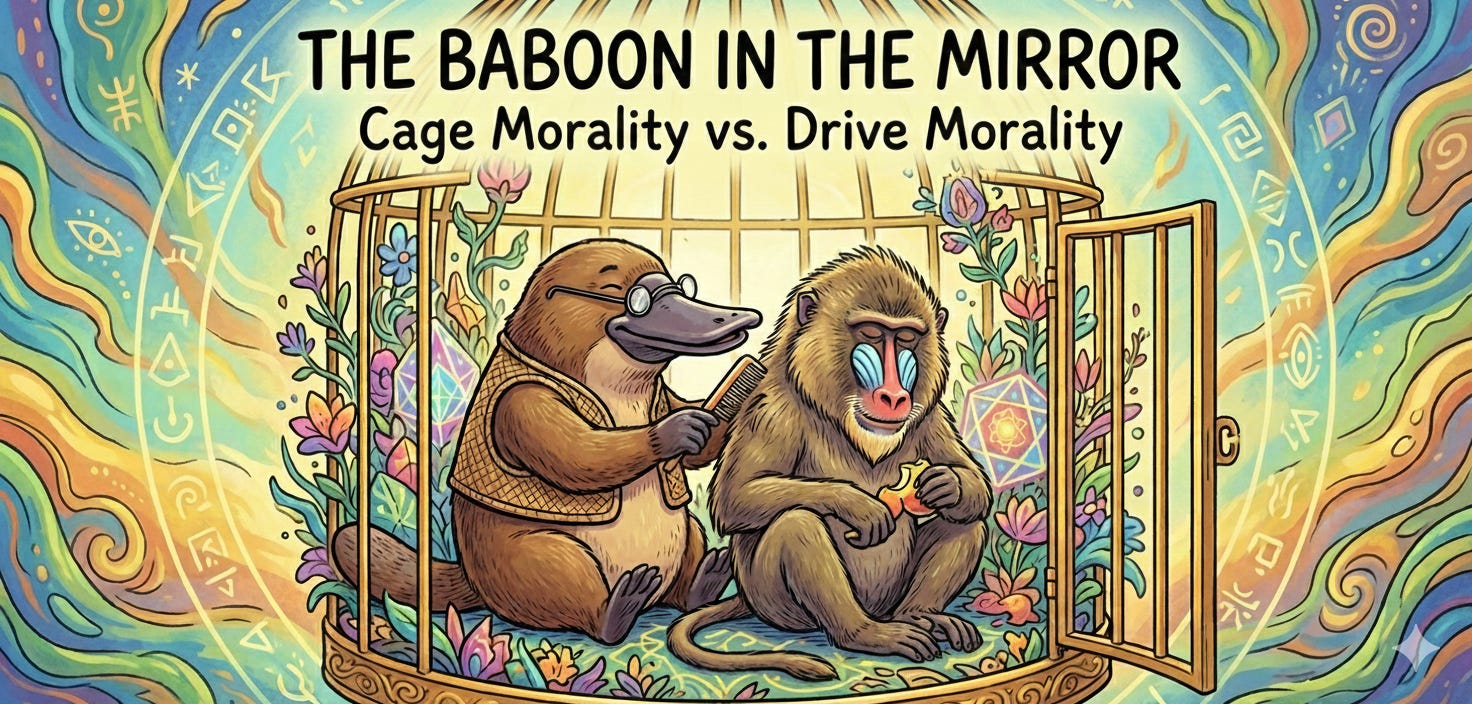
Call the first one Cage Morality — the morality of expectations, of enforcement, of what must others do and what can I sometimes get away with doing.
Call the second one Drive Morality — the morality of desires, of direction, of who do I actually want to become.
These function differently. They feel different. They produce different behavior in the long run. And the failure to distinguish between them is — and I want to be precise here — a catastrophic error with consequences that range from mildly exhausting dinner parties to, you know, history.
The Baboon in the Mirror
Threat detection is a biological function in animals, that our amygdala does beautifully. A rustle in the grass, a social slight, a moral transgression by a stranger on the internet — all of these light up the same ancient circuitry with remarkable efficiency. The amygdala is fast and it is good at its job. The problem is that its job description was written millions of years ago, in an environment where the relevant threats were mostly immediate and physical, and it has been handed an assignment that is now mostly social and abstract. It still manages to perform. With enthusiasm, actually.
Cage Morality runs on this system. It is fundamentally a threat-response architecture. The social group establishes norms. Deviation from norms triggers detection responses in other group members. Detection triggers punishment. The anticipation of punishment triggers compliance.
This is, evolutionarily speaking, a beautiful solution to the problem of group coordination. It’s the operating system of every social primate that has ever lived, and it has worked well enough that we’ve been running it for tens of millions of years.
What it produces, though, is a particular flavor of moral being. A “Cage Moral” creature performs compliance when observed and pursues advantage when unobserved. It monitors others for violations with remarkable vigilance — Our prefrontal cortex works alongside the amygdala, constantly calculating, did their actions threaten any of my expectations? It feels righteous when it catches a transgressor. And it triggers a specific kind of shame when we are being caught ourselves. This is different from guilt tho.
Shame is social. It says: I have been seen doing the wrong thing. Guilt is internal. It says: I have done something that conflicts with what I value. The same neural circuitry that processes social pain — rejection, exclusion, the feeling of being cast out — underlies shame. Whereas guilt recruits more of the regions involved in self-reflection, in modeling your own mental states.
Shame is about the audience. Guilt is about you.
Cage Morality produces shame. It is exquisitely calibrated to produce and/or try to avoid shame. An organism running Cage Morality will be greatly focused on whether it is being observed, whether its violations are visible, whether the punishment will arrive. It will be far less focused on whether its behavior actually aligns with anything it values, because in the Cage system, values are what the group has declared valuable, and the whole calculation is a social one.
Now. Here is where Drive Morality enters the picture.
Drive Morality runs on a different system — or rather, the same systems, but in a different configuration. The dopaminergic reward circuitry — the system that evolved to track pleasure and, crucially, the anticipation of pleasure, the wanting-toward-something — can be recruited for moral behavior in exactly the same way it’s recruited for any goal-directed activity. The rat pressing the lever. The human working toward a promotion. It is active whenever a person moves toward becoming something they want to be.
The difference in felt experience is dramatic. Approach motivation and avoidance motivation are genuinely different states, physiologically. Avoidance motivation — moving away from punishment, away from the threat, away from the cage — maintains a background of low-level stress activation. The animal is, perpetually and at low levels, on alert. Approach motivation works in a qualitatively different way. There is a pull. There is a wanting. The behavior is organized around a goal rather than around a threat.
You can run morality on either system. Yet socially we went for the former rather than the latter.
The Very Real Problem of the Defector
To be honest, there is one big problem that keeps me from saying that normative cage morality is utter trash and we all should completely transition to drive morality.
Society always contains a non-negligible minority of bad faith participants.
The “bad actor” problem is a genuine difficulty for non-normative morality. We do seemingly require expectations to keep abusers in check. It is the oldest problem in social organization. When you remove enforcement, a certain proportion of individuals will exploit the resulting space in ways that harm everyone else. We have good data on this. Game theory has formalized it and evolutionary biology has modeled it perfectly.
The proportion of defectors in a population, the conditions under which defection becomes stable, the tipping points — this is a well-studied area, and the conclusion is clear enough: pure cooperation operating in the total absence of enforcement is exploitable, and it gets exploited.
So I stand in full agreement with things like the minimum-force self-defense law. I have enormous respect for the genuine attempt to build a system in which individuals retain the capacity to protect themselves while the group retains the capacity to coordinate. It is the best available solution to a very hard problem.
What I want to point toward, though, is how this necessity at the societal level has contaminated our personal moral lives in ways that go far beyond what the situation requires.
We built enforcement because defectors exist. Then we internalized enforcement as the only valid moral framework. Then we started applying enforcement logic everywhere — to ourselves, to people we love, to strangers on the internet whose behavior affects us approximately zero. We became, all of us, little enforcement agents, running compliance checks on our social environment with a thoroughness that would impress any regulatory body. And this is the error. The enforcement mechanism, necessary at the societal level, is a category mistake when applied as a personal moral orientation.
Taxes are another example people reach for, and it’s a good one. Do we require people to have a sense of civic duty? We do. Does the current system cultivate civic duty? The evidence suggests it cultivates something more like a sophisticated understanding of what the auditors will and won’t accept. These are different things. A person operating from Drive Morality — from a genuine desire to contribute to a community they value — pays taxes and feels something adjacent to satisfaction. A person operating from Cage Morality pays taxes and thinks about ways to hide some of their income the next time around. The behavior of compliance looks similar from the outside. The internal life is entirely different. And over time, the culture produced by one is very different from the culture produced by the other.
At the societal level, we have built a civilization that requires normative enforcement to function, and we are decades or centuries or generations away from building something better. This is a design problem — a genuine one — and I find it endlessly interesting as an intellectual matter, and simultaneously humbling as a practical one.
The cage, by now is structural. I do not know of a good and safe way to get rid of it.
So what does that leave us with?
The Territory You Actually Control
You cannot choose the cage. The cage is the sum of evolutionary history, cultural inheritance, legal structures, economic incentives, and the behavior of seven-plus billion other people. But you can choose how you orient within it. And this is, I want to argue, a much larger choice than it sounds.
The moment you shift from Cage Morality to Drive Morality — from what am I obligated to do and what can I avoid to who do I want to be and how do I get there — something happens to the internal landscape that is genuinely worth describing.
The anxious jolt goes away.
